Wealth planning
Mallorca Property Through a Foreign Company: Tax Costs
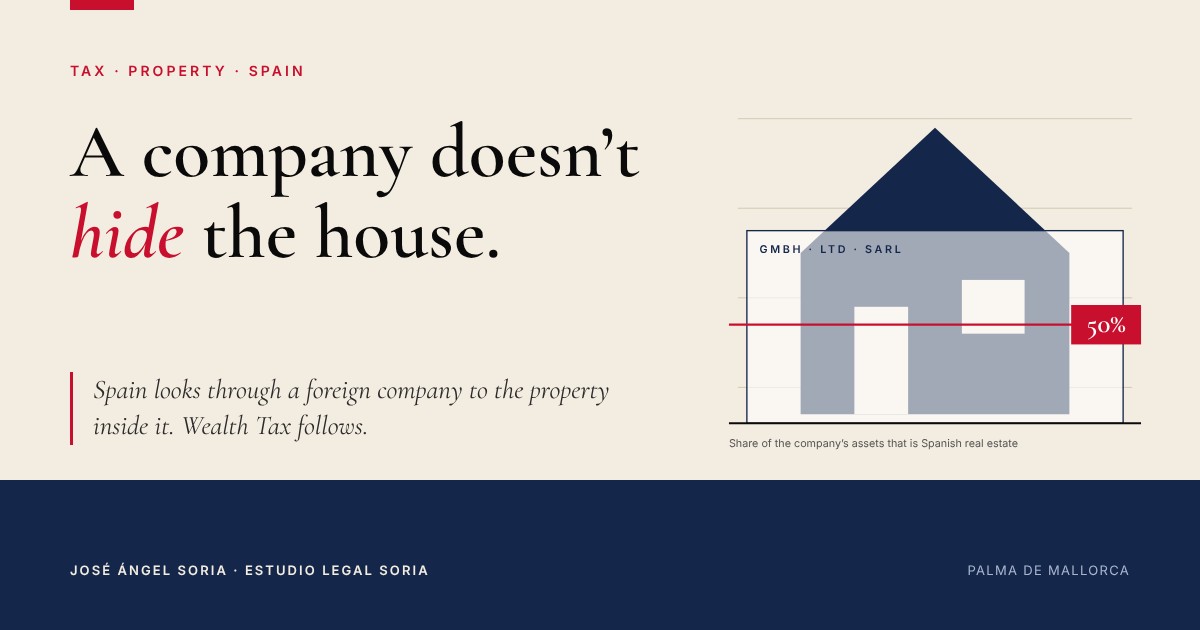
A foreign company rarely saves tax on a Mallorca home, and for a house the family lives in it may cost more. The 3% special levy usually does not apply, but the company does not remove Spanish Wealth Tax, and on one reading of the rules, which I have not seen tested, it can add Spanish income tax when the owners use the house.
Holding a villa in a GmbH, a Ltd or a SARL is often sold as a shortcut. Below: where the cost comes from, a worked example, and when a company does pay off.
Is the 3% special tax on foreign companies the problem?
Usually not. Spain charges a special annual levy of 3% of the cadastral value on property owned by foreign entities, but only entities resident in a country or territory that Spain classes as non-cooperative (arts. 40 to 45 of the Non-Resident Income Tax Law, RDLeg 5/2004). A German GmbH, a French SARL or a UK Ltd is not in that group.
The levy also has exceptions. Entities that run a real economic activity beyond holding or leasing property, and listed companies, are outside it (art. 42). The regulation sets the tests: the property is worth no more than five times the assets used in the activity, or the annual turnover is at least four times the levy base or at least €600,000 (art. 20.2 of the Non-Resident Income Tax Regulation). If it does apply, it is due every January on form 213 (the annual return for this levy), and the tax office can enforce against the property if it is not paid (art. 45).
Situation as of 16 November 2026. The list of non-cooperative jurisdictions changed with Order HAC/649/2026, published on 27 June 2026 and in force from 28 June. It removed Barbados, Dominica, Gibraltar, Samoa (for its offshore regime), Seychelles and Trinidad and Tobago, and added Russia from 28 December 2026. The order has a transitional rule for tax periods that had not ended, and the levy falls due on 31 December without a tax period in the usual sense. My reading is that the new list applies to the 2026 levy, but the order does not say so expressly. A company in one of the removed places should treat 2026 with caution. Lists change, so check before 31 December.
Order HAC/623/2026 (23 June 2026) changed mainly form 210, the non-resident income tax return, with new fields for days of use and ownership share, for returns filed from 2027.
The Balearic Wealth Tax exempt minimum of €3 million (art. 8 of Legislative Decree 1/2014) is written for people who live in the Balearic Islands. Non-residents may apply the rules of the region where most of their Spanish assets are (additional provision 4 of the Wealth Tax Law), and I do not resolve here whether that includes the exempt minimum.
From 1 January 2027 deemed income on a home follows a scale applied to the sum of a person's cadastral values: 1.1% up to €100,000, 1.5% up to €500,000, 2% up to €1 million and 3% above (Royal Decree-Law 29/2026, validated on 12 November 2026). On €400,000 that is €5,600, not the €8,000 used in the example below, which widens the gap to about €12,600.
My earlier article on the Gibraltar blacklist and Mallorca property covers the levy itself. Here I look at ordinary EU companies, where the levy is rarely the issue.
Where does the cost come from?
1. Wealth Tax on the shares, not only on the house
A non-resident individual who owns unlisted shares in a company is taxed in Spain on those shares if at least 50% of the company's assets, directly or indirectly, are Spanish real estate (art. 5.One.b of the Wealth Tax Law, Law 19/1991, in the wording of Law 38/2022). The count uses the values the law gives for each asset: other assets at market value, and for real estate, the highest of the cadastral value, the value checked by the tax office and the purchase price (art. 10). The shares are then valued by their book value in the last approved balance sheet if it was audited with a favourable report. If not, the highest of nominal value, book value and 20% capitalisation of the average profit of three years applies (art. 16). The cadastral value (valor catastral) is the Spanish tax-registry value of the property, usually well below market price, and it appears on your IBI bill.
The Spain-Germany treaty points the same way. Article 21.4 allows Spain to tax wealth made of shares in a company whose assets are at least 50% real estate located in Spain. So holding the villa through a company does not take the villa out of Spanish Wealth Tax. Wealth Tax is still due, now on the shares.
2. Income tax when the owners use the house
An individual who owns a Spanish home for personal use is taxed on a small notional income, a percentage of the cadastral value, even if the house is never rented (art. 24.5 of the Non-Resident Income Tax Law). A company has no such imputed income: that rule is for individuals (art. 13.1.h).
A company has no deemed income, which does not end the matter: a shareholder is a related party of the company (art. 18.2 of the Corporate Income Tax Law, from a 25% holding), dealings between related parties are valued at market price (art. 18.1), and art. 15.2 of the Non-Resident Income Tax Law points to those related-party rules for non-resident entities. In my reading, a company that lets a shareholder live in its Spanish house for free is giving a benefit worth a market rent, and the Spanish tax office can tax it. The tax authority's binding reply V2993-21 (25 November 2021, a Polish company) points the same way for partners and directors who are related parties, and it leaves room to show that nothing was owed when the partners are not related. I have not found a reply for a German or UK company, and who is taxed, at what rate and with which expenses depends on the facts. The table shows what happens if the tax office takes the market-rent view.
What does it cost in practice?
As an example, imagine a German resident who owns a Mallorca villa through a German GmbH. The villa cost €2,400,000, its cadastral value is €400,000, and the company's only other asset is €300,000 in cash. The family uses the villa all year, and a fair rent for it would be €6,000 a month.
| Item | Through the company | Owned personally |
|---|---|---|
| Real estate share of assets | 88.9% (€2.4m of €2.7m), above 50% | Not applicable |
| Wealth Tax in Spain | May be due on the shares, by the 50% rule | May be due on the villa |
| Income the tax office could attribute for the family's use (my reading, not settled) | €72,000 market rent | €8,000 imputed (2% of €400,000) |
| Income tax at 19% (German resident) | €13,680 | €1,520 |
| Extra income tax a year (Wealth Tax difference not quantified) | €12,160 | Reference |
Illustrative figures, not a forecast for your case. 19% applies to residents of EU or EEA states with exchange of information (art. 25). A UK-resident owner would be taxed at 24%, which changes the figures, and I have not run that case. I assume a 2% imputation rate. The rate is 1.1% if the municipality's cadastral values were revised recently (art. 85 of the Personal Income Tax Law and its additional provision 55), and the gap then grows to about €12,800. The table leaves out the expenses that EU-resident entities may deduct when they are directly tied to the Spanish income (art. 24.6), which would reduce the gap, the Wealth Tax bill, and whether a German partnership is taxed as a company or as a pass-through, taxed in its partners' hands. The tax authority has compared a German limited partnership (KG) to a pass-through entity in earlier replies, so a KG may change the picture. The table is a hypothesis, and free use by a shareholder could also be treated as a dividend or a benefit in kind in the shareholder's home country.
Wealth Tax may be due in both columns, depending on the exempt minimum and regional rules, so the company does not remove it. The base is not identical: the shares carry the cash and a different valuation rule. I do not put a figure on it because the Wealth Tax bill depends on the owner's other assets and on the regional rules that may apply. The difference is the income tax: up to about €12,000 a year more through the company before expenses, if the market-rent view holds, plus the accounts and filings the company needs. If the same company sat in a non-cooperative jurisdiction, the 3% levy would add €12,000 (3% of the cadastral value).
These figures are Spanish tax only. Whether you can credit them against tax at home, and how your home country treats the company, is a question for an adviser there. The treaty rules I cite are the Spain-Germany ones, and the tax authority applied them in binding reply V0107-23 (1 February 2023) to a German resident holding 25% of a German limited partnership whose only asset was a property in Ibiza: Spanish Wealth Tax applies to the holding if the property is at least 50% of the partnership's assets, the shares are valued under art. 16 of the Wealth Tax Law with the debts on the partnership's balance sheet deductible, and no Wealth Tax is due if foreign investments push the Spanish real estate below 50%. The Spain-UK treaty differs and I do not cover it here.
The 50% test is a threshold, and I do not suggest changing assets just to get under it.
When does a company pay off?
A company can make sense when the house is a business: you rent it out under a real operation, with staff or services, or you hold several properties together. Then the company has substance and expenses are deductible against the rent. Note that renting alone does not exempt a company from the 3% levy: the exception needs an economic activity beyond holding or leasing the property. It can also help when several family members share ownership and you want one decision-maker. Those reasons are about control and business.
A Spanish company is a different tool, with its own rules. I explain it in the guide to holding company structures for Spanish property. If you already own through a foreign company and are thinking of unwinding it, the tax cost of leaving is a separate question, and the exit tax article covers the Spanish side of one common case.
Questions to ask yourself
- A foreign company owns, or is about to buy, a home in Mallorca.
- The owners or their family use the house, with no market rent paid.
- More than half of the company's assets are the Spanish property.
- You are not sure whether Spanish returns are due for the company or its shareholders.
These are prompts for a conversation with an adviser, not a diagnosis.
Common mistakes
Assuming the company removes Wealth Tax
The 50% rule looks through the company to the real estate. Check the ratio at 31 December each year.
Letting the family use the house for free
Without a market rent, the Spanish tax office could, on one reading, treat the use as income. Whether a lease is needed, and at what rent, depends on the facts.
Counting on the 3% levy exceptions without evidence
The exception for entities with real activity needs facts that can be shown, and renting the property out is not enough on its own. A company that only holds a family home will usually struggle to show real activity.
Ignoring the filings
The returns for non-resident entities and shareholders (form 213 for the levy, form 210 for non-resident income tax, and the Wealth Tax return) have different deadlines. Missing one costs surcharges and, for the levy, a charge on the property.
My approach is to start with who uses the house and whether the company has real activity. If the answer is "the family, with no business", some owners look at holding the home personally, or at the Spanish tax cost of unwinding the company. That is a decision for after the documents are read.
If a rental business exists or is planned, the company can be right, and the work is to document the rent and the substance. This is a general view, not advice for your case.
Frequently asked questions
Does Spain charge 3% a year on property owned by a foreign company?
Only if the owner is resident in a country or territory that Spain lists as non-cooperative. A company in Germany, France or the UK is not in that group. Entities with a real economic activity and listed companies are also outside the levy.
Does owning a Mallorca home through a company avoid Wealth Tax?
Generally not. A non-resident who owns shares in a company whose assets are at least 50% Spanish real estate is taxed in Spain on the shares. Below 50%, this particular rule does not apply, but other rules can still reach the shares, for example when they give a right to use the property. The count is made on the legal values of each asset, not on the market value alone.
Can I live in a house owned by my company without paying tax?
It is risky. A shareholder with 25% or more, or a director, is a related party of the company, and related-party dealings are valued at market price. On one reading, free use is a benefit worth a market rent. I have not found a ruling that settles it. Whether a lease is needed depends on the facts.
Do I need a Spanish company to buy a property in Mallorca?
No. An individual can buy directly, and a foreign company can also buy. A notary will ask for proof that the company exists and for the identity of the people behind it. Whether a company is useful is a tax and control question, not a legal requirement.
Is a company better if I rent the property out?
It can be, when the rental is run as a real business, with substance and documented rents. Then expenses are deductible. For the 3% levy, renting alone does not exempt a company, which needs an activity beyond holding or leasing the property. For an occasional rental of a family home, a company rarely adds value.
Can I sell the shares instead of the property?
Spain can tax the gain on shares of a company whose assets are mostly Spanish real estate. The Spain-Germany treaty says so in article 13.2, and other treaties differ. Shares that give a right to use the property can also be caught. Selling shares does not remove Spanish tax by itself.
General information, not advice for your case, and not advice on German, UK or French law. The result depends on facts that only show up when the documents are read.
José Ángel Soria: How I Can Help You
Almost 30 years of professional experience. My background includes investment banking, in derivatives, at Goldman Sachs (New York) and Deutsche Bank (London), and a spell at American Express (Madrid). If a foreign company owns your Mallorca home, we start with who uses it and what the company does. I will explain the steps and give you a fee estimate if you decide to proceed.
Book a 30-minute consultation (€200 VAT included)If you then hire me for the work, the €200 is deducted from the total fee for that work. There is no obligation to hire me after the consultation. Bring the company's accounts, the property deed and any lease.
Please do not include confidential details of your case when booking. Controller: José Ángel Soria Sánchez (Estudio Legal Soria). Purpose: managing your booking. Legal basis: pre-contractual measures at your request (art. 6.1.b GDPR). Recipient: Cal.com, our calendar provider; any transfer outside the EEA is explained in the privacy policy. Retention, your rights and how to complain to the Spanish data authority (AEPD) are in the privacy policy.
Sources consulted for this article:
Non-Resident Income Tax Law, consolidated text, RDLeg 5/2004, arts. 13, 15, 24, 25 and 40 to 45 (BOE-A-2004-4527)
Wealth Tax Law 19/1991, arts. 5, 10 and 16, as amended by Law 38/2022 (BOE-A-1991-14392)
Corporate Income Tax Law 27/2014, art. 18 (BOE-A-2014-12328)
Order HAC/649/2026, published 27 June 2026, on non-cooperative jurisdictions (BOE-A-2026-13946)
Order HAC/623/2026 on forms 210, 213, 216 and 296 (BOE-A-2026-13573)
Spain-Germany tax treaty, arts. 13, 21 and 22 (BOE-A-2012-10212). German, UK and French law is not covered.
Binding replies V0107-23 and V2993-21 of the Dirección General de Tributos: I read the official texts published by the tax authority.
Balearic Legislative Decree 1/2014, art. 8 (BOE-A-2014-6925). Non-Resident Income Tax Regulation, art. 20 (BOE-A-2004-14532). Royal Decree-Law 29/2026 (BOE-A-2026-20823).
Last reviewed: 16 November 2026
This is general information based on the law on the date shown, not advice for your case. Reading this article does not create a lawyer-client relationship or guarantee any tax saving. Tax rules and their interpretation can change, and your result depends on the documents of your company and property.
Lawyer, member of the Ilustre Colegio de Abogados de las Islas Baleares (no. 5971)
Author and responsible lawyer. Estudio Legal Soria, Palma de Mallorca