Property law
A €2M Farmhouse in Mallorca: What a Buyer's Lawyer Found in the Planning File
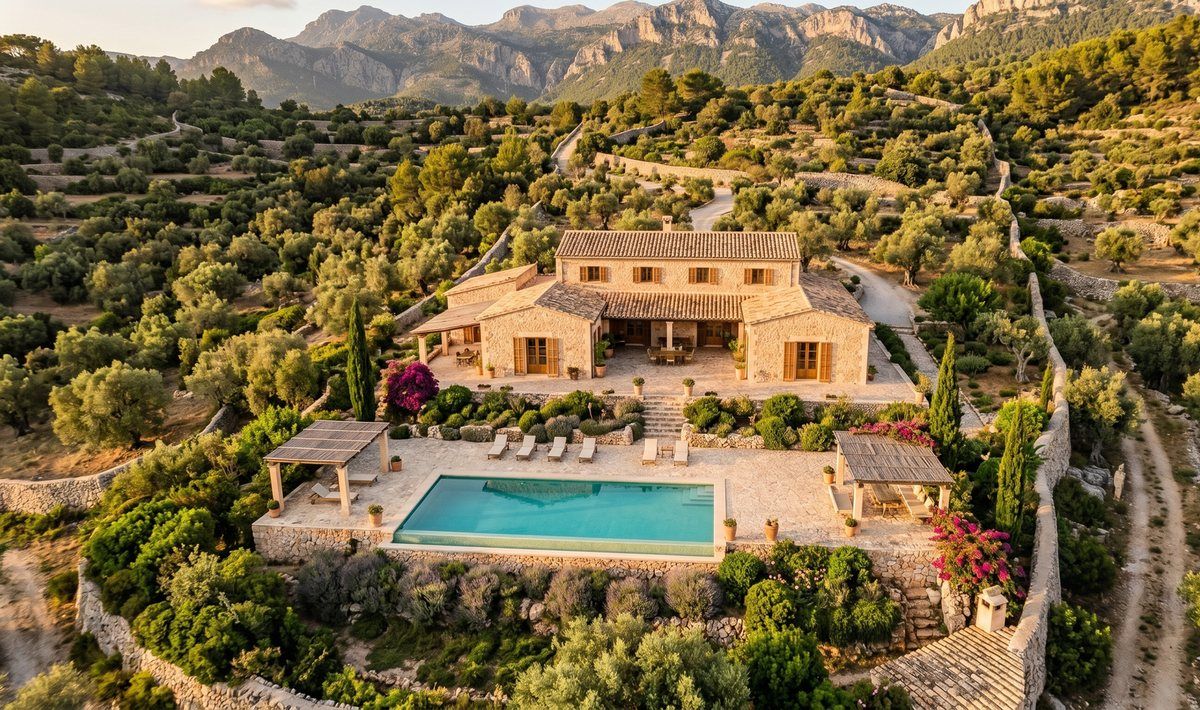
Case based on a real matter
Published with the client's written consent. I have changed or rounded details, including figures and dates, to protect the client and the property. What matters here is the legal analysis. What happened in one matter does not guarantee the outcome of another.
The situation
A buyer from northern Europe was about to complete on a traditional stone farmhouse in the Mallorcan countryside, for around €2 million. The price was agreed, the title deed was clean and the Land Registry extract showed no charges. The municipal planning file had not been reviewed yet.
He asked me to review the purchase shortly before completion, and I asked for a few days to go through that file.
What the file showed
Two works without a licence.
The pool
Built more than eight years earlier and never legalised. It already appears in the aerial photographs, and there was no record of any council action. The land was classified as common rustic land (suelo rústico común).
The extension
Added to the main house many years before, it exceeded the maximum buildable area allowed for that land. It was habitable and in good condition, which did not change its legal position.
What "prescribed" means, and what it does not
This distinction is what the price discussion turned on. Under the Balearic planning law (Law 12/2017), the council can start a procedure to restore planning legality only within eight years after the work is completely finished, and the opening resolution must have been notified, or notification legally attempted, within that period (art. 196.1). That limit does not apply on protected rustic land (art. 196.2.a). Until 13 December 2024 the same article made all rustic land imprescriptible, and for works finished before 2018 the earlier rules may apply, so the date, the classification of the land on that date and the rules in force then must be checked. The burden of proving the completion date falls on whoever invokes prescription (art. 196.3), which after the purchase would be the buyer, so without proof I cannot rely on it. Any evidence admitted in law counts, and aerial photographs, final-works certificates, local taxes and invoices are the usual material.
Both works here were older than eight years, and both were finished before 2018, so the time limit has to be checked under the rules in force when each work was completed, and not only under Law 12/2017. On common rustic land, and if the dates can be proved, the council may no longer be able to order them undone. Whether the 2024 narrowing of art. 196.2.a helps a work whose eight years ran out before that date depends on the transitional rules, so I do not treat it as settled.
But prescribed is not legal. A work the council can no longer order undone stays outside the planning rules (fuera de ordenación) until it is legalised (art. 129.2). For a work built without a licence, such as the pool, that means no works of any kind except repairs for health, safety or hygiene (art. 129.2.b). For an extension to a lawful house, the lawful part can still be repaired, consolidated and reformed, as long as the works do not touch the unlawful part, where, once restoration can no longer be demanded, only repairs for health, safety or hygiene are allowed (art. 129.2.c). For works built after 1 March 1987 without a licence, the supply of electricity, water and the other utilities cannot be contracted either (art. 129.2.b), which matters in practice to a buyer.
What I did
Why foreign buyers miss this
In some buyers' home countries, planning status is easy to check and rarely changes over time. The idea that a perfectly liveable extension built decades ago can carry lasting restrictions does not come naturally.
Balearic rural land works differently. A construction that exceeds the permitted parameters is not automatically demolished, yet it can carry limits that stay with the property until it is legalised and affect its value whenever you renovate or sell. The Land Registry extract does not show this, and it is not part of what a notary or the Registry is there to confirm. It sits in the municipal file, and someone has to ask for it.
What I ask first, and what I check next
When a client describes a rural property in Mallorca, my first questions are whether there is a pool, an extension or an outbuilding. If the answer to any of them is yes, the planning file needs to be checked before anything is signed. For each work, I then check three things, in this order:
- When was it finished, and what is the proof? Without a proved date there is no prescription to rely on, and I also check whether a restoration or sanction file was already opened and notified.
- What was the land classification that day, and what is the use today? If the land was protected or the use changed, the time limit changes.
- Can it be legalised, and at what cost? Mallorca has an extraordinary legalisation route, with a deadline and a cost set as a percentage of the works (see the dated box below), and a constitutional challenge to it is pending, so check its current status before relying on it. I explain it in What the Amnesty Actually Covers.
My view
If the seller can prove the dates, the land was common rustic land on those dates, and the works fit a legalisation route, I would accept the risk that remains at a price that already discounts it. If the dates cannot be proved, I would not sign: without proof I cannot rely on prescription, and the risk stops being the cost of regularising it and becomes a possible demolition order.
Most of the damage in these purchases comes from questions nobody asked. Whether an unlicensed pool is a problem or only looks like one is something you can answer before signing, though not with certainty, because the council's decision and any change in the rules remain open. This is a general opinion on one kind of case, not advice for yours.
José Ángel Soria, Abogado ICAIB 5971
Frequently asked questions
Common questions from international buyers of rural property in Mallorca
Can the council still order demolition of a pool built more than eight years ago on common rustic land?
Possibly not, if the completion date can be proved. In the Balearic Islands the procedure to restore planning legality can only start within eight years after the work is completely finished, and the opening resolution must be notified, or notification legally attempted, within that period (art. 196.1 of Law 12/2017). The limit does not apply to works on protected rustic land (art. 196.2.a). Until December 2024 all rustic land was imprescriptible, and for works finished before 2018 the earlier rules may apply, so the date, the land classification at that date and the transitional rules have to be checked case by case.
If a work is prescribed, is it legal?
No. A work the council can no longer order undone stays outside the planning rules (fuera de ordenación) until it is legalised (art. 129.2 of Law 12/2017). For a building or structure built without a licence, only repairs for health, safety or hygiene are allowed (art. 129.2.b). For an extension to a lawful house, the lawful part can be repaired, consolidated and reformed as long as the works do not touch the unlawful part, where, once restoration can no longer be demanded, only repairs for health, safety or hygiene are allowed (art. 129.2.c). For works built after 1 March 1987 without a licence, the supply of electricity, water and the other utilities cannot be contracted either (art. 129.2.b), which matters in practice to a buyer.
Does the nota simple show planning problems?
No. It shows ownership and registered charges. It does not show licences, the planning history of the property, its land classification or any disciplinary proceedings. A clean nota simple is where due diligence starts, not where it ends.
If the seller did not mention the planning issues, can I claim afterwards?
Possibly, but it is hard and not something to plan on. If the seller knew and stayed silent, a claim for fraud under articles 1269 and 1270 of the Civil Code may exist, decided case by case. Serious fraud allows annulment, and incidental fraud gives compensation only. The annulment action lapses four years after the contract is fully performed (art. 1301). If you saw the work on your visit, the seller will argue there was no deception, and the deed may carry clauses selling the property as seen or waiving claims over its planning status.
Should each work on the property be checked separately?
Yes. Each work has its own completion date, and land classification can differ between the parcels of the same finca. A pool, an extension and an outbuilding can each be in a different position.
José Ángel Soria: How I Can Help You
My background includes investment banking, in derivatives, at Goldman Sachs (New York) and Deutsche Bank (London), and a spell at American Express (Madrid). When I read a planning file, I separate what is proved from what is still open. If you are looking at a finca with a work that has no licence, I will tell you plainly what you can rely on and what you cannot.
Book a 30-Minute Consultation30-minute initial consultation: €200, VAT included.
You pay when you book, by card (Stripe), in the Cal.com calendar. You get an invoice. If I cannot take your matter, I refund the amount. How we use your data: privacy policy.
Sources consulted for this article:
Ley 12/2017, de 29 de diciembre, de urbanismo de las Illes Balears, arts. 129 and 196 (BOE-A-2018-806), consolidated text consulted on 17 November 2026
Ley 7/2024, de 11 de diciembre, de medidas urgentes de simplificación y racionalización administrativas, art. 54 and disposición adicional séptima (BOE-A-2025-720), consolidated text consulted on 17 November 2026
Código Civil, arts. 1269, 1270 and 1301 (BOE-A-1889-4763)
Last reviewed: November 2026
This is general information based on the law on that date, not advice on your specific situation. Reading it does not create a lawyer-client relationship or guarantee any outcome.
Lawyer, ICAIB 5971, Ilustre Colegio de Abogados de las Islas Baleares
Written and reviewed personally, Estudio Legal Soria, Palma de Mallorca