Civil litigation
Selling an Inherited Property in Spain as a Non-Resident
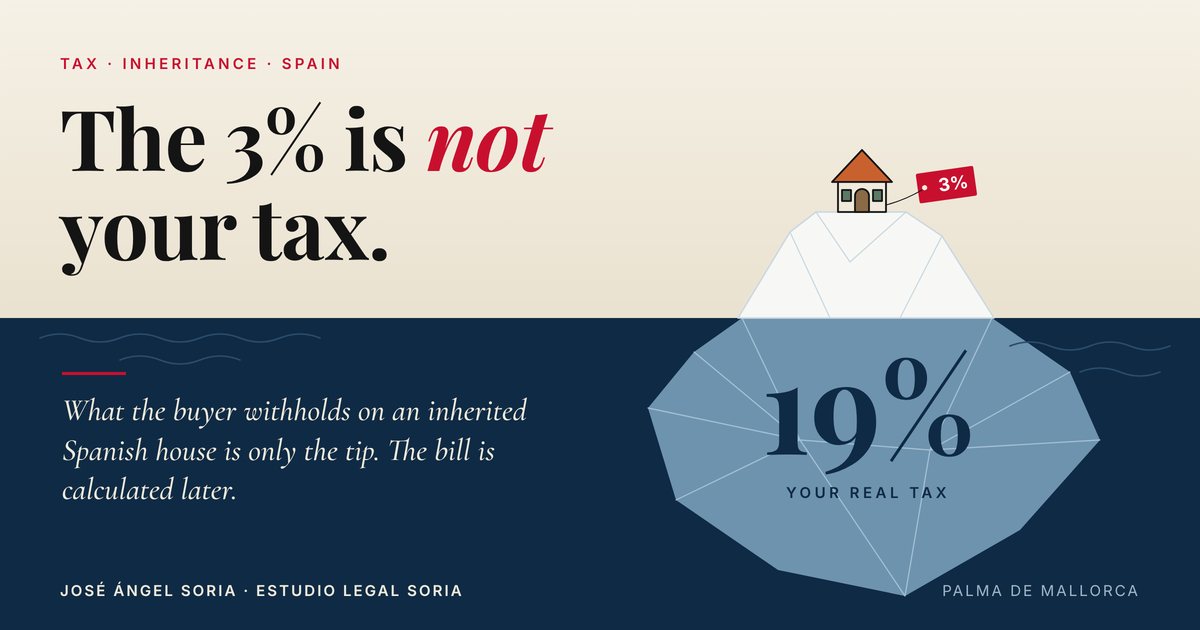
If you sell an inherited Spanish house as a non-resident, the buyer's 3% withholding is only an advance. Your real tax is 19% of the gain, measured from the value declared in the inheritance, not from what your parent paid.
In the Balearic Islands, the value declared in the inheritance is usually just the reference value published by the Catastro. For a spouse, child or parent the 100% inheritance tax bonus (a full reduction of the tax payable) makes the tax zero anyway, so nobody asks whether a higher figure would help. It would help when you sell. The bonus is all or nothing: go more than 20% above the reference value and you lose all of it.
This guide covers a property in the Balearic Islands inherited from someone who lived there, or whose Spanish assets are mostly there. The 3%, the 19% and the sale deadlines apply across Spain. Only the inheritance tax value and the bonus are regional.
If you have not filed the inheritance tax return yet and may sell, work out the sale tax before you choose the value. The return is due six months from the death, and can be extended by another six if you ask in the first five months (arts. 67 and 68 of the Inheritance and Gift Tax Regulation).
Why the 3% is not your tax
Think of the 3% as the pre-authorisation a hotel puts on your card at check-in. It is held against the final bill, but it is not the bill. If the bill is smaller you get the difference back. If it is larger, you pay the rest.
The final bill is Spain's capital gains tax for non-residents (non-resident income tax, IRNR). The rate is 19% of the gain, the same for every non-resident (art. 25.1.f of the Non-Resident Income Tax Law). When a non-resident sells Spanish property, the buyer must withhold 3% of the agreed price and pay it to the tax office within one month of the sale (form 211). You then file your own return (form 210) within three more months, so about four months in all. For example, if you sell on 15 March, the buyer pays by 15 April and you file by 15 July. You file whatever the result, even if you owe nothing. The 3% is credited against your tax, and if more was withheld than you owe, the tax office refunds the difference (art. 14 of Royal Decree 1776/2004, and art. 16 for refunds).
The regulation refunds the excess afterwards. It does not set out a way to reduce the 3% at the time of the sale. The buyer will insist on withholding it, because if it is not paid the property itself stays liable for the smaller of the retention and the tax, and the registrar notes that on the title.
The sequence of a sale
| When | What happens |
|---|---|
| Before listing | The inheritance is accepted and registered in your name. The buyer's notary and the registry need it. More in Inheriting property in Spain as a non-resident. |
| Day of the sale | The buyer withholds 3% of the price from what they pay you. |
| Within one month | The buyer files form 211 and pays the 3%. They give you a copy as proof. |
| About four months after the sale | You file form 210, normally online with a Spanish tax number (NIF), and settle the difference or claim the refund. If you have no NIF and tax is due, the tax office allows payment by bank transfer from abroad with an identification code. |
The number that sets your tax: your starting value
Your gain is the sale price, minus what the sale cost you, minus your starting value (the tax basis). For an inherited house, the starting value is not what your parent paid. It is the value that came out of the inheritance tax return, never above market value, plus the taxes and costs of the inheritance (arts. 35 and 36 of the Personal Income Tax Law, which apply to non-residents through art. 24.4 of the IRNR Law). The death itself produces no gain (art. 33.3.b).
In the Balearics the starting value works like this. For real estate, the inheritance tax value is the reference value (valor de referencia) published by the Catastro, unless you declare more (art. 9.3 of the Inheritance and Gift Tax Law). It is not the cadastral value on your IBI bill. You can look it up on the Catastro's website with the cadastral reference of the property. The 100% bonus for the spouse, descendants and ascendants is lost if the value in the deed is more than 20% above that reference value (art. 36 of Legislative Decree 1/2014). So the reference value is the floor and the reference value plus 20% is the ceiling. The reference value is an administrative figure, and it can sit well below what the house sells for.
Which region's rules apply to a non-resident heir? If the person who died lived in a Spanish region, that region's rules apply to you even though you live abroad. If the person who died was not resident in Spain, it is the region where most of the Spanish assets are (additional provision 2 of the same Law). A German or British heir of a parent who lived in Palma gets the Balearic rules: they apply to non-resident heirs wherever they live.
If you have already filed with the lower value, your starting value is whatever the return says, unless it is formally corrected. That depends on your documents and dates, so ask before you list the house, and bring the inheritance deed, the filed return and the reference value of the property.
There is one exception that works against you. If you received the property under a succession agreement with immediate effect (pacto sucesorio, a Balearic form of succession contract, usually signed during the owner's life) and sell within five years of the agreement or of the death, whichever is earlier, you must take over the previous owner's value and date when that value was lower (art. 36 of the Personal Income Tax Law).
A worked example
Hypothetical example, not a real client.
As an example, imagine Hannah. She lives in Germany and inherits from her mother, who lived in Palma, a flat with a reference value of €300,000. The flat was worth about €400,000 on the date of death. The inheritance is declared at the reference value, the 100% bonus applies and no inheritance tax is due. The notary, registry and gestor for the inheritance cost her €4,665. Two years later she sells for €450,000 and pays her agent 3% plus VAT, €16,335.
Hannah assumed the 3% was the end of it. The low declared value costs her €11,400 more tax than the alternative below. After the €13,500 already withheld, she still has to pay €11,010.
| A. Declared at €300,000 | B. Declared at €360,000 | |
|---|---|---|
| Declared value vs reference value | At the reference value | At reference value + 20% |
| Sale price | €450,000 | €450,000 |
| Selling costs (agent 3% + VAT) | €16,335 | €16,335 |
| Starting value (declared + €4,665) | €304,665 | €364,665 |
| Gain | €129,000 | €69,000 |
| Tax at 19% | €24,510 | €13,110 |
| Withheld by the buyer | €13,500 | €13,500 |
| Result with form 210 | pay €11,010 | refund €390 |
Illustrative figures. They assume the Balearic bonus applies, the same inheritance costs in both columns, and no municipal plusvalía or home-country tax.
Compare A and B. One number changes: the value written in the inheritance return. In B, Hannah pays €11,400 less tax and no extra inheritance tax, because €360,000 is within the 20% margin and below what the flat was really worth. And if you sell soon after the inheritance for close to the declared value, there is little or no gain and most or all of the 3% comes back.
If you expect to sell within a few years and you get the 100% bonus (spouse, descendants, ascendants), I would declare as high as the market value you can document, and never above the reference value plus 20%. Keep a valuation report from the date of death: Spain accepts a starting value only up to that market value, and you carry the burden of proof.
For siblings, nephews and uncles the bonus is 60% when no descendants concur, and for other group III relatives 35% (art. 36 bis of the Balearic Decree), with the same 20% ceiling. A higher declared value then raises your inheritance tax, so the trade-off is real and depends on your figures. More distant relatives get no regional bonus.
A higher declared value can also raise the base for Spanish wealth tax while you own the house. Whether that matters depends on your total Spanish assets and the exempt minimum, so check it before choosing the value.
If you plan to keep the house for decades, the low value usually does you little harm today, but it stays as your starting value if you ever sell. This is a general view, not advice for your case. It depends on your residence, your documents and your home-country tax.
Plusvalía municipal, twice
Plusvalía municipal is the town hall's tax on the increase in the value of urban land. It can reach you twice.
Situation as of 3 November 2026. Royal Decree-law 29/2026 (art. 10) changes the maximum plusvalía coefficients from 1 December 2026. They go up for most holding periods (for example, 10 years: from 0.12 to 0.22; under one year: from 0.15 to 0.17) and fall only for 19 years (from 0.23 to 0.20) and for 20 years or more (from 0.40 to 0.30). It is in force, but the Permanent Deputation of Congress (the Cortes are dissolved) must still convalidate it, and press reports expect the vote on 12 November. If it is not convalidated, the current maximums stay. Each town hall sets its own coefficients up to those maximums.
It taxes the land, not the building. The heirs pay it when the owner dies, within six months, extendable to one year. Your town hall may reduce it by up to 95% for close relatives (art. 108.4 of the Local Finance Law), so check.
The second time is when you sell. You do not pay it if the land did not gain value, and you can ask to be taxed on the real gain if that is lower (arts. 104.5 and 107.5); you must declare the sale and show the deeds. When the seller is a non-resident individual, the buyer is the one who files and pays it to the town hall (art. 106.2) and can claim the amount back from you (art. 36.3 of the General Tax Law). Expect them to discount it from the price, and ask for the figure before you agree on the price.
Two things that work against you
A loss on this sale does not offset a gain on anything else (art. 15.1 of the IRNR Law), so a loss simply disappears, apart from the refund of what was withheld. And the reinvestment relief only covers the sale of what was your habitual home in Spain, and only for residents of the EU, or of the EEA when there is effective exchange of tax information (additional provision 7). It rarely helps with an inherited house you used for holidays.
If you spend a lot of time in Spain, check whether you are a tax resident first, because the rules change completely. I explain the three tests in Spanish tax residency: are you already a resident without knowing it?
When there are several heirs
Each heir is a separate taxpayer. The buyer withholds 3% on each heir's share, and each heir files their own form 210 with their own starting value. Costs are deductible only by whoever paid them, so agree in writing who pays what and keep the invoices in the right name. One heir can end up with a refund and another with a payment, because their costs differ.
Your home country may tax it too
Spain taxes the gain because the house is in Spain. Your country of residence may tax it as well, and its starting value can differ. In some countries the starting value is the market value on the date of death, in others it is the original cost. A double tax treaty may give you a credit for the Spanish tax or allocate the gain to one country, depending on the treaty. Whether you live in Germany, the UK or elsewhere, ask a tax adviser in your country before you sign the sale.
Does this apply to you? Four signals
- You live abroad and have inherited, or are about to inherit, a property in Spain.
- You think you may sell it in the next few years.
- You do not know what value the inheritance return declares, or it has not been filed yet.
- There are several heirs, or the house is worth much more than the reference value.
If two or more fit, the numbers are worth running before you sign the sale contract. For the wider picture of non-resident taxes, see non-resident tax on Spanish property.
Frequently asked questions
How much tax do I pay when I sell an inherited property in Spain as a non-resident?
19% of your gain, which is Spain's capital gains tax for non-residents. The gain is the sale price, minus the costs of the sale you paid, minus your starting value. The starting value is the value declared in the inheritance tax return, never above market value, plus the costs and taxes of the inheritance. The 3% the buyer withholds is an advance on that tax, not the tax itself.
Is the 3% withholding the final tax, and can I get it back?
It is not the final tax. It is credited against your 19%, and if more was withheld than you owe, the tax office refunds the excess. You must file your own return (form 210) within four months of the sale, even if the result is zero. If you miss that deadline you can usually still file late to claim the refund, normally within four years of the end of the filing period. Late filing when tax is due brings surcharges, and a small fixed fine can also apply (arts. 27 and 198 of the General Tax Law).
Is my starting value what my parents paid?
No. For an inheritance it is the value declared in the inheritance tax return, not exceeding market value, plus the taxes and costs of the inheritance. What your parent paid years ago does not count. The exception is a succession agreement with immediate effect: if you sell within five years, you must take over the previous owner's value when it was lower.
Do I pay the municipal plusvalía when I sell?
The tax applies to sales of urban land, but it is not due if the land did not gain value, and you can ask to be taxed on the real gain if that is lower. When the seller is a non-resident individual, the buyer files it and pays it to the town hall, so in practice it is dealt with in the price negotiation. Heirs also pay it once, when the owner dies.
Can I sell before the inheritance is registered?
In practice, no. The buyer's notary and the Land Registry will ask for the property to be registered in your name first, so the inheritance has to be accepted, taxed and registered before you can complete a sale.
What documents do I need to sell an inherited property in Spain?
The sale cannot be registered until the property is registered in your name (art. 20 of the Mortgage Law), so most of the paperwork belongs to the inheritance: the death certificate, the certificate of last wills, the will or, without one, the declaration of heirs, and the deed accepting and dividing the inheritance. The Land Registry also needs proof of the inheritance tax, and a tax identification number for every party to the deed, which for a foreigner means the NIE (art. 254 of the Mortgage Law). If you cannot attend, a power of attorney lets someone sign for you.
How long does the whole process take?
There is no fixed length, because most of the time goes on the inheritance, not on the sale. Inheritance tax is due within six months of the death (extendable by another six if you ask in time), and registration speed depends on the Land Registry, so I would not promise a number. After the sale, the tax cycle is short and fixed: the buyer pays the 3% within one month and you file form 210 within three months after that, about four months in all.
There are three of us. Who files what?
Each heir files their own form 210 for their share, and the buyer withholds 3% on each share separately. Costs are deductible only by the heir who paid them, so agree in writing who pays which cost and keep the invoices in the right name.
Do I have to file in Spain if I sold at a loss?
Yes. The buyer still withheld 3%, and the way to get it back is to file form 210. File it within the four months. A loss on this sale cannot be used against any other gain.
General information, not advice for your case. The result depends on facts that only show up when the inheritance documents and the sale contract are read.
José Ángel Soria: How I Can Help You
My background includes investment banking, in derivatives, at Goldman Sachs (New York) and Deutsche Bank (London), and a spell at American Express (Madrid). If you have inherited a house in Mallorca and may sell it, we start with one number: the value in your inheritance. I will tell you what it means for the sale, and what it costs.
Book a 30-minute consultation (€200 VAT included)If you then hire me for the work, the €200 is deducted from the total fee for that work. There is no obligation to hire me after the consultation. Bring the inheritance deed, the filed inheritance tax return and the reference value of the property.
Please do not include confidential details of your case when booking. Controller: José Ángel Soria Sánchez (Estudio Legal Soria). Purpose: managing your booking. Legal basis: your request. Recipient: Cal.com, our calendar provider. Retention, your rights and how to complain to the Spanish data authority (AEPD) are in the privacy policy.
Sources consulted for this article:
Royal Legislative Decree 5/2004, Non-Resident Income Tax Law (TRLIRNR), arts. 15.1, 24.4, 25.1.f and 25.2, and additional provision 7
Royal Decree 1776/2004, Non-Resident Income Tax Regulation, arts. 14 and 16
Order EHA/3316/2010, arts. 5 (as rewritten by Order HAC/623/2026), 8.5, 12 and 14
Law 35/2006, Personal Income Tax Law, arts. 33.3.b, 34, 35 and 36
Law 29/1987, Inheritance and Gift Tax Law, art. 9 and additional provision 2, and Royal Decree 1629/1991, Inheritance and Gift Tax Regulation, arts. 67 and 68
Balearic Legislative Decree 1/2014 (devolved taxes), arts. 36 and 36 bis
Royal Legislative Decree 2/2004, Local Finance Law, arts. 104, 106, 107, 108 and 110
Law 58/2003, General Tax Law, arts. 27, 36.3, 66 and 198
Law 19/1991, Wealth Tax Law, art. 10
Last reviewed: 3 November 2026
This is general information based on the law on the date shown, not advice for your case. Reading this article does not create a lawyer-client relationship or guarantee any tax saving. Tax rules and their interpretation can change, and your result depends on the documents of the inheritance and of the sale.
Lawyer, member of the Ilustre Colegio de Abogados de las Islas Baleares (no. 5971)
Author and responsible lawyer. Estudio Legal Soria, Palma de Mallorca