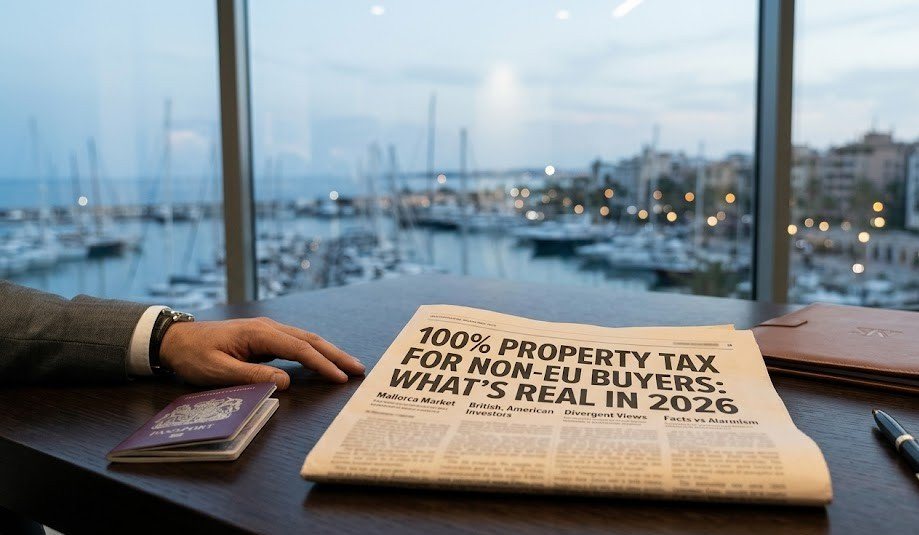
Where the Proposal Came From
In January 2025, Spanish Prime Minister Pedro Sanchez announced, at an economic forum, that the government was considering restricting property purchases by non-EU, non-resident buyers as part of a broader package of housing affordability measures. The announcement generated significant media coverage and considerable confusion, partly because the initial framing was imprecise.
On 30 May 2025, the Socialist Parliamentary Group (PSOE) formalised the proposal by submitting a draft law to the Spanish Parliament — Proposicion de Ley 122/000196 — which included the creation of a new "Complementary State Tax on Real Estate Transfers to Non-EU Residents." That document is publicly available in the Official Gazette of the Spanish Parliament.
That is the last significant formal step. As of May 2026, the tax has not been approved, not been voted on, and has not entered into force. It remains a parliamentary proposal under debate, subject to amendment, rejection or approval — none of which has yet occurred.
What the Proposal Actually Says
Who it would affect
The proposed tax would apply exclusively to individuals and legal entities who are not resident in any EU member state and who purchase second-hand residential property in Spain. This means it would affect British nationals without Spanish or EU residency, along with buyers from the United States, Canada, China, the Middle East, and other non-EU countries who do not hold a Spanish or EU residence permit.
It would not affect EU citizens, regardless of nationality. It would not affect non-EU nationals who hold a valid Spanish or EU residence permit. And it would not affect buyers who acquire new-build property directly from a developer — because new builds are subject to VAT rather than Transfer Tax, and the proposed surcharge operates alongside the Transfer Tax system.
How it would work financially
The proposal establishes a complementary state tax equal to 100% of the taxable base of the property — which is determined by whichever is higher between the declared purchase price, the market value, and the cadastral reference value. This surcharge would be applied on top of the existing regional Transfer Tax (ITP), which in the Balearic Islands currently runs between 8% and 13% of the purchase price depending on the value bracket.
In practical terms: a non-EU, non-resident buyer purchasing a second-hand property in Mallorca for 1,500,000 euros would pay the standard Balearic ITP — roughly 150,000 to 195,000 euros — plus an additional 1,500,000 euros in the new complementary tax. The ITP already paid would be deductible from the new surcharge, but the net additional burden would still be close to the full value of the property.
Why It May Never Pass — or May Pass Very Differently
The parliamentary arithmetic
The Spanish government does not currently hold a parliamentary majority. Any legislation requires support from other parties, and this proposal — which is a Proposicion de Ley from the PSOE group, not a government bill — faces significant political opposition. As of May 2026, no vote has taken place and no firm timeline for a vote has been announced publicly.
The legal challenges
The proposal faces serious legal objections from multiple directions. Spanish constitutional law scholars have raised the question of whether a 100% tax on asset value could be classified as confiscatory, which would violate the proportionality principles embedded in the Spanish Constitution. EU law raises a separate and arguably more serious problem: Article 63 of the Treaty on the Functioning of the European Union prohibits restrictions on the free movement of capital not only between EU member states, but also between EU member states and third countries. Spain has already been condemned by the European Court of Justice for discriminatory tax treatment of non-resident property owners on previous occasions. The risk of a legal challenge succeeding — and the tax being struck down or significantly modified after passage — is real and has been acknowledged by multiple Spanish tax law specialists.
The political signal versus the legal reality
It is worth being direct about what this proposal is, in part: a political signal. Non-EU buyers represent a relatively small share of total Spanish property transactions — estimates range from 3% to 8% depending on the methodology. The housing affordability problem in Mallorca and other high-demand areas is structural, driven primarily by insufficient supply and planning constraints, not by non-EU buyer activity. The proposal's political purpose — to demonstrate action on housing — may not translate into the law passing unchanged, or passing at all.
What This Means Practically for Non-EU Buyers Considering Mallorca
If you are currently in the process of buying
The tax is not in force. Your transaction proceeds under existing rules. There is no legal basis to delay, accelerate or modify a purchase specifically because of this proposal — it remains a proposal. What matters is ensuring your due diligence is thorough and your legal position is solid under current law, because that is what applies today.
If you are planning to buy in the next 12 to 24 months
This is where monitoring matters. If the proposal advances through Parliament and a vote appears likely, the relevant strategic questions are: Does your situation qualify for any of the exemptions? Would obtaining Spanish residency before completing the purchase take you outside the scope of the tax? Is the property you are considering a new build — and therefore exempt under the current proposal? These are not hypothetical questions. They are planning questions with concrete answers that depend on your specific circumstances.
The residency route
One immediate consequence of this proposal — whether or not it passes — is that it has renewed interest in Spanish residency options among non-EU buyers. The Golden Visa real estate route was abolished in April 2025, but other pathways remain: the Non-Lucrative Visa for those with sufficient passive income or savings, the Digital Nomad Visa for remote workers, and the Entrepreneur Visa for those establishing a business. Obtaining Spanish residency before a property purchase would, under the current proposal, take the buyer outside its scope entirely. Whether pursuing residency makes sense in your situation depends on factors well beyond the property transaction itself.