Property law
Rustic Property in Mallorca: The Legal Traps That Catch Foreign Buyers After Signing
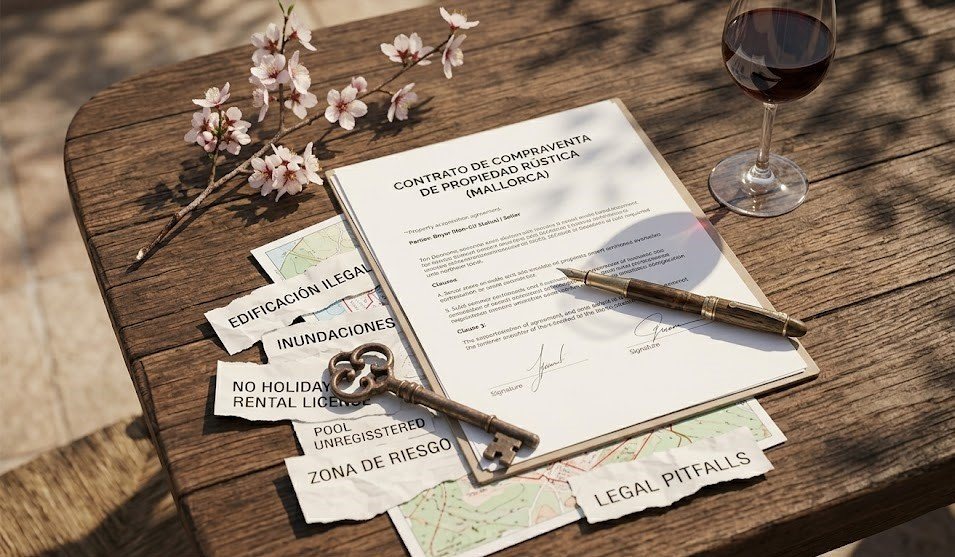
The finca has almond trees, sea views and a freshly renovated pool. The agent says everything is in order. What the agent does not say is that the guest house has no licence, the pool is not registered, the land is in a flood-risk zone, and a recent legalisation means you can never use it as a holiday rental. This is how foreign buyers lose money on rustic property in Mallorca — and how to avoid it.
Key figure: It is estimated that there are more than 25,000 illegal or irregular constructions on rustic land in the Balearic Islands. Many owners — and many buyers — do not know it. A cédula de habitabilidad does not confirm legality. An agent’s assurance does not confirm legality. Only a proper legal and technical report does.
Why Rustic Property in Mallorca Is a Different Legal World
Urban property in Mallorca — an apartment in Palma, a townhouse in Pollensa — comes with a relatively straightforward legal framework. Rustic property is different. Suelo rústico — rural land — is subject to a separate set of planning rules, environmental protections and building restrictions that do not apply to urban land. And the history of rural Mallorca includes decades of construction that took place without proper licences, in areas where the administration either could not or chose not to enforce the rules.
The result is a market where a significant proportion of premium rural properties carry legal problems that are invisible to the untrained eye — and where the cost of discovering those problems after signing can run into hundreds of thousands of euros.
"The seller often does not know either. An owner who bought the property years ago and has used it without problems may be genuinely unaware that part of what they are selling was never legal."
The Six Traps That Catch Foreign Buyers
- Unlicensed constructions — pools, guest houses, extensions The main house may be fully legal. The pool, the guest cottage, the garage, the covered terrace added in 2003 — may not be. If those structures are not registered in the Land Registry or Catastro, or were built without a licence, you inherit the problem the moment you sign. The administration can order demolition even if it was built by the previous owner decades ago.
- Flood-risk zones (zonas inundables) Mallorca’s flood maps — available at visor.aigua.caib.es — classify significant areas of rural land as flood-risk. Properties in these zones face restrictions on renovation, extension and new construction. Insurance is harder to obtain and more expensive. And this information does not appear in the nota simple — it requires a separate check of the Balearic water authority’s map before any offer is made.
- Protected land classifications Mallorca has multiple categories of protected rustic land — ANEI (natural interest areas), ARIP (landscape interest zones), APT (territorial planning areas) — each with different building restrictions. A plot marketed as having “building potential” may in fact be SRP (Sòl Rústic Protegit), where no new construction is permitted at all. Checking the catastral classification and the municipal planning map is not optional.
- The minimum plot size myth Many buyers are told that a rustic plot of 14,000 m² is buildable. In general terms, 14,000–15,000 m² is the standard minimum in Mallorca for a new residential build on rustic land. But each of Mallorca’s 53 municipalities has its own planning regulations, and in some zones — particularly ARIP areas — the minimum can be 50,000 m² or even 100,000 m². “Buildable” is not a simple yes or no. It requires a written informe urbanístico from the relevant Ajuntament.
- The legalisation amnesty trap Balearic Decree-Law 3/2024 (May 2024), now consolidated into Law 7/2024, created a pathway to legalise certain irregular constructions on rustic land where the planning infringement is already time-barred — broadly, structures built before May 2016 in non-protected areas. This is sometimes presented as unambiguously good news for buyers. It is not always. Properties legalised under this mechanism cannot be used for tourist rental activity — and this restriction must be noted in the Land Registry. A buyer who pays a premium for a finca with a recently legalised guest cottage, expecting to generate holiday rental income, may find that the legalisation itself has permanently closed that door.
- Discrepancy between registry, catastro and physical reality It is common for rustic properties in Mallorca to show significant differences between what is registered in the Land Registry, what appears in the Catastro (the cadastral survey), and what actually exists on the ground. Plot boundaries may be wrong. Buildings may not appear in either record. Rooms, terraces and outbuildings may exist physically but not legally. A nota simple alone is not enough — a full technical and legal report comparing all records against physical reality is the minimum standard for a safe purchase.
What the 2024 Legalisation Decree Actually Says
The opportunity
Decree-Law 3/2024, approved by the Balearic Government on 24 May 2024 and subsequently consolidated into Law 7/2024 of December 2024, created a structured pathway for the extraordinary legalisation of buildings and constructions on rustic land where the administration’s right to enforce planning compliance has already expired. In practice, this covers constructions built before May 2016 in non-protected areas, and before March 1991 in protected areas.
The process requires an architect to prepare a legalisation project, payment of a licence fee plus a surcharge (10% of the licence value in year one, rising to 15% in year three), compliance with energy efficiency and water management requirements, and approval by the relevant authority. Where successful, it converts a property from planning limbo into a regularised legal status — which can increase its value by as much as 30% according to industry estimates.
The trap
The legalisation comes with a permanent condition that is easy to miss and impossible to reverse: properties legalised under this decree cannot be used for the commercial letting of tourist stays. This restriction must be expressly noted in the Land Registry entry. A property that carries this notation cannot obtain a tourist licence — now or in the future — regardless of its location, size or condition.
Before buying any rustic property that has been recently “regularised” or “legalised”: check the Land Registry entry for any notation relating to Decree-Law 3/2024 or Law 7/2024. If it is there, the property cannot generate tourist rental income. If you were planning to use it as a holiday let, this changes the investment case entirely.
The Due Diligence That Actually Protects You
Standard due diligence for urban property — nota simple, check for charges, review of community statutes — is not sufficient for rustic property in Mallorca. A proper rural property review requires all of the following before the Contrato de Arras is signed:
- Nota simple from the Land Registry — ownership, charges, encumbrances, and any planning-related notations including legalisation restrictions
- Catastral report — comparing registered plot size and structures against physical reality
- Informe urbanístico from the Ajuntament — confirming the planning classification of the land and what is or is not permitted
- Flood map check — via the Balearic water authority’s online viewer (visor.aigua.caib.es)
- Building licence history — confirming which structures have valid licences and which do not
- Cédula de habitabilidad — the occupancy certificate, and whether it is current and valid (note: its existence does not confirm planning legality)
- Tourist licence status — if rental income is part of the plan, whether a licence exists, whether it is transferable, and whether any legalisation notation prevents future licensing
- Water supply verification — confirming whether supply is mains, well (with licence from the water authority), or shared agreement
- Access rights — confirming legal access to the property, particularly relevant for isolated rural plots
This review requires both a specialist property lawyer and, in most cases, a local architect or technical engineer. It takes time. It costs money. It is the single most important investment a buyer of rural property in Mallorca can make.
Frequently Asked Questions
The agent told me the property has a cédula de habitabilidad, so it must be legal. Is that right?
No. The cédula de habitabilidad is an occupancy certificate issued by the Town Hall confirming that the property meets basic habitability standards. It does not confirm that all constructions on the property have valid building licences, that the plot classification permits the use, or that there are no open planning enforcement proceedings. It is a necessary but not sufficient document. Legality requires a full review of licences, catastral records and planning classification — not just the cédula.
Can I demolish an illegal structure and rebuild it legally after purchase?
Not necessarily, and in many cases no. On protected rustic land, the removal of an existing structure — even an illegal one — does not automatically create a right to rebuild. In some protected categories, once a structure is demolished it cannot be replaced. The answer depends entirely on the planning classification of the specific plot, the category of protection, and current municipal regulations. This must be confirmed before purchase, not assumed.
The property was recently legalised under the 2024 amnesty. Is that a good thing?
It depends entirely on your plans. If you intend to use the property as a private residence and have no interest in tourist rentals, legalisation under Decree-Law 3/2024 resolves a problem and potentially increases the property’s value. If you intended to generate holiday rental income, the legalisation may have permanently foreclosed that option — because properties legalised under that decree cannot be used for tourist letting, and this restriction is noted in the Land Registry. Always check the full terms of any legalisation before factoring rental income into your purchase decision.
Can I claim against the seller if I discover illegal constructions after signing?
Potentially yes, under the hidden defects regime of the Spanish Civil Code (arts. 1484–1490) or, where the defect is sufficiently serious, under the broader contractual non-performance regime. However, the six-month forfeiture period of article 1490 means you must act quickly, and the case depends heavily on whether the defect was genuinely hidden or should have been discovered with proper due diligence. Prevention — a thorough legal review before signing — is significantly more reliable than litigation after the fact. We cover hidden defects claims in detail in our article on structural faults and hidden defects in the Balearic Islands.
How long does a proper rural due diligence take?
A thorough review of a rustic property in Mallorca — covering all the elements described in this article — typically takes two to four weeks from instruction. Some elements, particularly the informe urbanístico from the Ajuntament, depend on the municipality’s response times. This timeline needs to be factored into any offer and negotiation. Signing a Contrato de Arras before due diligence is complete is one of the most common and costly mistakes a buyer can make.
How I Can Help
I am a practising lawyer (ICAIB 5971) with almost 30 years of professional experience, and I advise buyers on property transactions in the Balearic Islands. Rural and rustic property due diligence is among the most complex work I do — and the most consequential. If you are considering a finca or rural property in Mallorca and want to know what you are actually buying before you commit, a 30-minute consultation is the right first step.
Book a Consultation — 200 EUR / 30 minBased in Palma. English and Spanish. I answer my phone.
30-minute initial consultation: €200, VAT included.
You pay when you book, by card (Stripe), in the Cal.com calendar. You get an invoice. If I cannot take your matter, I refund the amount. How we use your data: privacy policy.
Sources consulted for this article
- Decreto-Ley 3/2024, de 24 de mayo, Govern de les Illes Balears — extraordinary legalisation of rustic constructions (BOE-A-2024-16940)
- Ley 7/2024, de 11 de diciembre, Illes Balears — consolidation of administrative simplification measures including legalisation pathway
- Ley 4/2025, de 18 de julio, Illes Balears — modifications to rustic land legalisation regime and PTI Mallorca
- Plan Territorial Insular de Mallorca (PTI) — rustic land classification and building restrictions
- Spanish Civil Code, arts. 1484–1490 — hidden defects and saneamiento regime
- Balearic water authority flood maps — visor.aigua.caib.es
- Last review: May 2026