Property law
Buying Property in Mallorca as a Non-EU Buyer in 2026: The Legal Reality
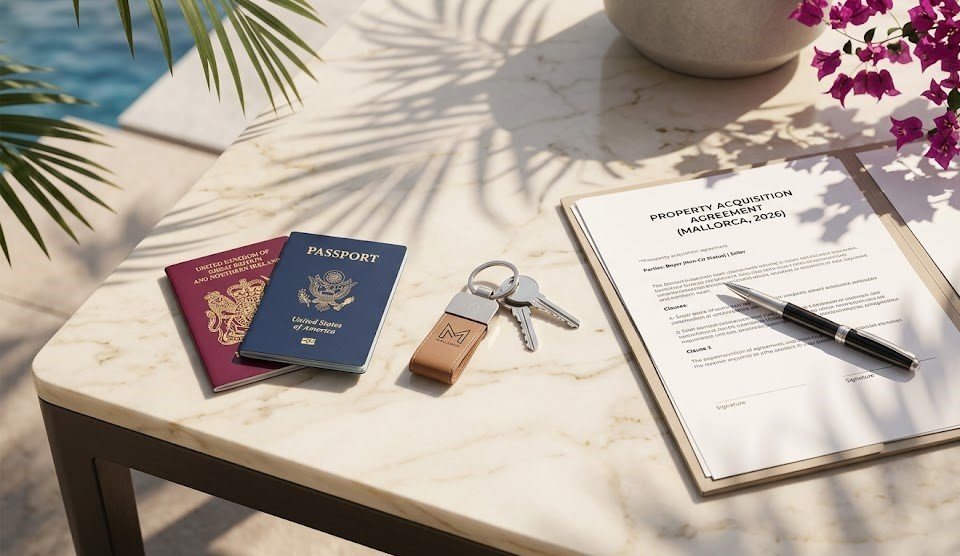
The headlines have been alarming. A 100% tax. A ban on foreign buyers. The end of the Golden Visa. If you are a non-EU buyer considering property in Mallorca in 2026, you need to know what is actually in force, what is not, and what the real legal risks are before you sign anything.
Key fact: Non-EU buyers can still purchase property in Mallorca in 2026. No ban has passed. No 100% tax is in force. The legal framework has not changed — but the landscape around it has shifted significantly, and the risks that were always there are now more important to manage than ever.
The Three Headlines — and What They Actually Mean
The 100% property tax
In May 2025, the Socialist Parliamentary Group submitted a proposal — Proposición de Ley 122/000196 — to create a complementary state tax equal to 100% of the purchase price for non-EU, non-resident buyers of second-hand residential property. As of May 2026, this proposal has not been voted on, has not been approved, and has not entered into force. It faces serious constitutional objections and significant parliamentary opposition. Every current purchase proceeds under existing tax rules.
We have covered this in detail in a separate article: Spain’s 100% Property Tax for Non-EU Buyers: What Is Actually Happening in 2026.
The Balearic ban on non-resident buyers
In February 2026, MÉS per Mallorca brought a proposal to the Balearic Parliament to prohibit non-residents from buying homes in the islands. On 24 February 2026, the proposal was voted down by PP and Vox. The legal framework has not changed. The Balearic property market remains fully open to international buyers. The headlines in the British press suggesting an imminent ban were inaccurate.
The end of the Golden Visa
This one is real and already in force. The real estate Golden Visa was abolished on 3 April 2025 by Organic Law 1/2025. Non-EU buyers can no longer obtain Spanish residency by purchasing property worth €500,000 or more. Other residency routes remain available — the Non-Lucrative Visa, the Digital Nomad Visa, the Entrepreneur Visa — but the property investment route is closed.
"The legal risks that matter for non-EU buyers in Mallorca in 2026 are not the ones generating headlines. They are the ones hiding inside the property itself."
What the Process Actually Looks Like in 2026
The legal steps — unchanged but more important than ever
The buying process for non-EU buyers in Mallorca follows the same structure it always has. What has changed is the regulatory environment around it — more scrutiny, more documentation, more anti-money laundering compliance — and the consequence of getting any step wrong is higher than it used to be.
- NIE (Número de Identificación de Extranjero) — mandatory before signing any contract or paying any tax. Apply at the Spanish consulate in your country or through a lawyer with power of attorney in Spain. Allow time: consulates in the UK are overloaded.
- Independent lawyer — not the seller’s lawyer, not the agent’s recommended lawyer. An independent abogado who reviews the nota simple, checks planning status, verifies there are no charges, encumbrances or urban infractions, and confirms that what is registered matches what physically exists.
- Spanish bank account — required for the transfer of funds, tax payments and ongoing costs. Anti-money laundering requirements have tightened significantly: non-residents need to document the origin of funds clearly and in advance.
- Contrato de Arras — private purchase contract with a 10% deposit. Once signed, the seller is bound. If the seller withdraws, they return double the deposit. If you withdraw, you lose it. The terms of this contract matter enormously and should not be signed without legal review.
- Escritura Pública — notarial deed signed before a Spanish notary. The notary confirms identity and capacity but does not perform legal due diligence. That is your lawyer’s job, not the notary’s.
- Tax settlement and registration — Transfer Tax (ITP) paid to the Balearic Government within 30 days of signing. Then registration at the Land Registry. Until registered, your ownership is not fully protected against third party claims.
The Tax Picture for Non-EU Buyers in 2026
| Tax / Cost | Rate | Notes |
|---|---|---|
| Transfer Tax (ITP) — resale | 8%–13% | Balearic scale: 8% up to €400k, rising to 13% above €2M |
| VAT — new build | 10% | Plus 1.5% Stamp Duty (AJD) |
| Notary and Land Registry | 0.5%–1% | Varies by property value |
| Legal fees | 1%–1.5% | Independent lawyer, recommended minimum |
| Annual IBI | Varies by municipality | Municipal property tax, paid by owner |
| Non-Resident Income Tax (IRNR) | 19%–24% of deemed income | Applies to non-residents on imputed rental income even if property is not rented |
Budget a total of 12%–15% on top of the purchase price for all acquisition costs on a resale property. On a €1.5 million purchase, that is €180,000–€225,000 in taxes and fees before you receive the keys.
The Real Risks — What the Headlines Are Not Covering
Rustic property and illegal construction
The premium Mallorca market is full of fincas, country villas and rural properties marketed as dream investments. Many of them carry legal problems that are invisible to a buyer without specialist due diligence. Extensions built without licence. Swimming pools not registered in the Land Registry or Catastro. Constructions on protected land or in flood-risk zones. Properties without a valid cédula de habitabilidad — the occupancy certificate without which you cannot legally inhabit the property, obtain a tourist licence, or in some cases get a mortgage.
The rule for rural property in Mallorca: Never rely on what the Land Registry shows. Never rely on what the estate agent says. The only protection is a legal and technical report that checks the nota simple, the catastral record, the municipal planning classification, the flood maps, and the history of building licences — before you sign the Contrato de Arras, not after.
Hidden defects in premium properties
Structural problems concealed under cosmetic renovations are a recurring pattern in the Balearic premium market. Spanish law gives you six months from delivery to act on hidden defects — and that deadline is a forfeiture period that cannot be interrupted. We have covered this in detail in our article on hidden defects claims in the Balearic Islands.
Tourist licence restrictions
If your purchase plan includes generating rental income — Airbnb or similar — the legal situation in Mallorca is significantly more restrictive than most buyers realise. New tourist licences for apartments in plurifamily buildings are effectively frozen in most of the island. Existing licences are valuable and finite. Before purchasing any property with rental income in mind, the licence situation must be verified as part of due diligence — not assumed.
Residency and the post-Golden Visa landscape
With the real estate Golden Visa closed, non-EU buyers who want to spend extended time in Spain need to plan their residency route separately from their property purchase. The Non-Lucrative Visa requires demonstrating passive income of approximately €2,400 per month. The Digital Nomad Visa requires remote employment or self-employment for non-Spanish clients. Neither is automatic or fast. If residency is part of your plan, it needs to run in parallel with, not after, the property process.
Frequently Asked Questions
Frequently Asked Questions
Can I still buy property in Mallorca as a British national after Brexit?
Yes. British nationals can buy property in Mallorca without restrictions. Since Brexit, UK citizens are treated as non-EU buyers under Spanish law, which means slightly more paperwork and higher Transfer Tax scrutiny, but no restriction on ownership. The proposed 100% tax has not passed. The Balearic ban was rejected. The NIE process, the buying steps, and the tax rates are the same as for any other non-EU buyer.
Do I need to be in Spain to complete the purchase?
No. A Power of Attorney (Poder Notarial) allows your lawyer to act on your behalf for all steps of the transaction, including signing the deed at the notary. This is common practice for international buyers. The Power of Attorney must be signed before a notary — either in Spain or at a Spanish consulate in your country — and apostilled if signed outside Spain.
What happened to the Golden Visa? Is there any alternative?
The real estate Golden Visa was abolished on 3 April 2025. There is no equivalent replacement that grants residency through property investment. The alternatives are the Non-Lucrative Visa (passive income requirement of approximately €2,400/month), the Digital Nomad Visa (remote work for non-Spanish clients), and the Entrepreneur Visa (establishing a business with economic interest for Spain). Each has different requirements, processing times and implications.
Is the 100% property tax going to pass?
As of May 2026, the proposal has stalled in Parliament. The government does not hold a majority, key coalition partners oppose it, and the proposal faces serious constitutional and EU law challenges. It has not been voted on and no firm timeline exists. That said, the political environment around foreign property ownership in Spain is more active than it has been in decades. Monitoring the situation is sensible; making purchase decisions based on a law that does not yet exist is not.
What is the most important thing I can do to protect myself as a non-EU buyer in Mallorca?
Hire an independent lawyer before you sign anything — including a reservation agreement. Not after. The stage at which most buyers make irreversible mistakes is the Contrato de Arras, which commits them to a purchase before due diligence is complete. A thorough legal review of the property — planning status, licences, charges, physical reality versus registry record — is the single most effective protection available. Everything else is secondary.
How I Can Help
I am a property and litigation lawyer based in Palma de Mallorca with almost 30 years of professional experience, advising non-EU buyers on property transactions in the Balearic Islands. I work in English and Spanish. If you are considering a purchase in Mallorca and want a clear picture of where you stand legally — before you commit to anything — a 30-minute consultation is the right first step.
Book a Consultation — 200 EUR / 30 minBased in Palma. English and Spanish. I answer my phone.
30-minute initial consultation: €200, VAT included.
You pay when you book, by card (Stripe), in the Cal.com calendar. You get an invoice. If I cannot take your matter, I refund the amount. How we use your data: privacy policy.
Sources consulted for this article
- Organic Law 1/2025, of 2 January — abolition of the real estate Golden Visa (in force 3 April 2025)
- Proposición de Ley 122/000196, PSOE — proposed 100% complementary tax (May 2025, not yet approved)
- Balearic Parliament plenary session, 24 February 2026 — rejection of MÉS per Mallorca non-resident purchase ban
- Spanish Civil Code, arts. 1484–1490 — hidden defects regime
- Balearic Islands Transfer Tax (ITP) scale — Agencia Tributaria Illes Balears (2026)
- Treaty on the Functioning of the European Union, art. 63 — free movement of capital
- Last review: May 2026